

















What Is the Cheapest Way to Ship a Box in the U.S.?
Shipping costs are one of those things that sneak up on you. You think you have a handle on it, and then the carrier invoice comes in and it is way higher than expected. Again. And you are not quite sure why.
The cheapest way to ship a box isn’t always the carrier with the lowest base rate. It depends on what you are shipping, how heavy it is, and how far it is going – and honestly, what box you put it in. That last part is something most businesses never think about. And it’s costing them money every single shipment.
This guide breaks all of it down: carriers, rates, flat rate vs. weight-based, and the packaging angle that most shipping guides completely skip over.
What Actually Determines the Cost of Shipping a Box?
Before you can find the cheapest way to ship a box, you need to understand what actually drives the cost. There are four main factors, and most people only think about one of them.
Actual Weight
This is the physical weight of the package on a scale. It is the obvious one. A heavier box costs more to ship. But it is not always the number that determines what you pay.
Dimensional Weight
This is the one that surprises people. Dimensional weight, also called DIM weight, is a calculated weight based on the size of the package rather than how heavy it actually is. Carriers use whichever is higher, actual weight or DIM weight, to set the price.
Here is how it works. You take the length times the width times the height of the box, divided by a DIM divisor (usually 139 for UPS and FedEx). This actually gives the DIM weight in pounds. If your box is large but light, like a candle in an oversized box with a lot of empty space, the DIM weight will be higher than the actual weight. And you will pay for the DIM weight.
This is the most misunderstood cost driver in shipping. A lot of small businesses are paying for air inside their boxes without knowing it.
Distance and Shipping Zones
Carriers divide the U.S. into shipping zones based on distance from the origin. Zone 1 is local. Zone 8 is cross-country. The further the package travels, the more zones it crosses, and the higher the cost. This is why the cheapest way to ship a large package cross-country looks very different from shipping the same package two states over.
Delivery Speed
Faster delivery costs more, and you know this already. Ground shipping is almost always the cheapest way to send a package if you have the time. Next-day and two-day services come at a significant premium. Unless your customer specifically needs it fast, ground is the move for cost-conscious shipping.
USPS vs. UPS vs. FedEx: Which Is the Cheapest Way to Send a Package?
There is no one-size-fits-all answer here because the cheapest carrier depends on the weight, size, and destination of your package. But here is a practical breakdown by weight band.
Under 10 lbs
USPS Ground Advantage is almost always the cheapest way to send a package under 10 lbs. USPS pricing for light packages is hard to beat, and they do not charge residential delivery fees, which UPS and FedEx both add to ground deliveries going to home addresses. For ecommerce businesses shipping lightweight products to residential customers, USPS is the default winner in this weight range.
10 to 20 lbs
This is where it starts to shift. UPS and FedEx Ground become more competitive as package weight increases. At this range, run a comparison. USPS still holds its own but UPS and FedEx can come in lower depending on the zone and the dimensions of the package.
Above 20 lbs
UPS Ground and FedEx Ground are generally more competitive for heavier packages, especially for longer distances. USPS flat-rate options can still win here if the package fits in a flat-rate box, but for non-flat-rate shipments above 20 lbs, UPS and FedEx usually have better rates.
Surcharges to watch out for
The base rate is not the full story. All three carriers add surcharges that inflate the final bill.
Residential delivery fees.
UPS and FedEx both charge extra for deliveries to home addresses. USPS does not. For any ecommerce business sending packages to residential customers, this difference adds up fast.
Fuel surcharges.
All three carriers apply a fuel surcharge that fluctuates and gets added on top of the base rate.
Dimensional weight penalties.
If your box is oversized relative to its weight, you get hit with DIM weight pricing on top of whatever the base rate is. This is where packaging choices directly affect your carrier bill.
Address correction fees.
If the shipping address has an error, carriers charge to correct it. Clean your address data.
Flat Rate vs. Weight-Based Shipping: Which Saves You More?
Flat rate shipping is one of those things that sounds simple but has real nuance to it. Here is when it works in your favor and when it doesn’t.
What flat rate actually means
With flat rate shipping, you pay a fixed price regardless of how much the package weighs, as long as it fits in the carrier’s flat-rate box. The distance doesn’t matter either. You pay the same rate whether you are shipping across town or across the country.
USPS Priority Mail Flat Rate goes up to 70 lbs and comes in several box sizes. FedEx has One Rate. UPS has Simple Rate. Each has its own box sizes and pricing.
When flat rate wins
Flat rate is the cheapest way to ship heavy items when the product is dense and compact. Think a heavy glass jar, a set of bottles, or anything that weighs a lot relative to its size. If you have a 15 lb product that fits in a flat-rate box and you are shipping cross-country, flat rate will almost certainly be cheaper than weight-based ground pricing over that distance.
The decision rule is straightforward. Heavy, compact item going a long distance? Flat rate wins. Light item or short distance? Weight-based wins.
When flat rate doesn’t work
If your product is light, flat rate is not going to save you anything. You are paying a fixed premium for a service that charges by weight up to 70 lbs. A 2 lb item shipping short distance through USPS Ground Advantage will be significantly cheaper than throwing it in a flat-rate box.
Also, flat-rate boxes have fixed dimensions. If your product doesn’t fit cleanly, you are forced into a larger flat-rate box, which may push you into a higher flat-rate tier. Always check whether the product actually fits before assuming flat rate is the best way to ship a package.
How Your Packaging Is Costing You More Than You Think
This is the part most shipping guides leave out. And it is arguably the most actionable section in this entire post.
Most businesses that overpay on shipping are not overpaying because of the carrier they chose. They are overpaying because of the box they used.
Oversized boxes and DIM weight
An oversized box creates wasted space. Wasted space inflates your dimensional weight. And inflated dimensional weight means you pay more than the physical weight of your product would require. This happens every single shipment. A box that is two inches wider and two inches taller than it needs to be is added to your carrier bill in a way that’s invisible unless you know to look for it.
Right-sizing your box to fit your product as closely as possible is one of the most effective ways to reduce shipping costs. You are not changing carriers. You are not negotiating rates. You are just using the right box.
Poorly packed boxes and reshipping costs
A box that is not properly packed results in movement during transit. Movement results in breakage. Breakage results in refunds, replacements, and reshipping.
And literally all the things mentioned above result in costs more than the original shipment. The best way to ship a box is one that arrives intact the first time.
Where Gorilla Shipper fits in
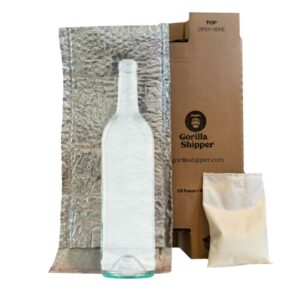
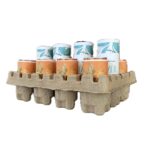
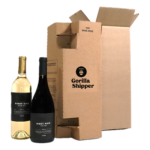
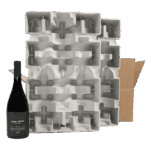
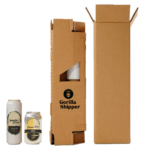
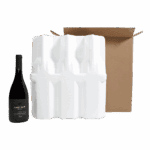
Our boxes are purpose-built for fragile ecommerce shipments. We have kept the dimensions compact. Why? Because the products should fit. None of our boxes are of some generic size that wastes space.
We ship flat-pack design so you are not storing pre-assembled boxes that take up your workspace. We are ISTA 6-FedEx-A certified. So now you don’t even have to worry about carrier compliance too!
A right-sized, certified box reduces your DIM weight charges before the carrier invoice is even generated. That is the upstream fix. Sort the packaging, and the shipping cost follows.
Cheapest Shipping Rates for Small Businesses: How to Pay Less Than Retail
Walking into a UPS or FedEx store and paying at the counter is the most expensive way to ship. Here is how small businesses actually reduce their per-shipment cost.
Buy postage online
USPS, UPS, and FedEx all offer discounts for postage purchased online vs. at the counter. USPS Commercial rates, available through their website and approved platforms, are meaningfully lower than retail rates. This is the simplest and most immediate change a small business can make.
Use multi-carrier rate comparison tools
Platforms like Pirate Ship, EasyShip, and ShipStation pull rates from multiple carriers simultaneously and show you the cheapest way to send a package for each specific shipment. You enter the dimensions, weight, and destination, and the tool tells you the best rate across carriers. These platforms also negotiate volume-based discounts on your behalf, so you get better rates than you could access directly as a small business.
Pirate Ship in particular is popular with small ecommerce businesses because it offers USPS Commercial Plus rates with no subscription fee.
Negotiate volume rates directly
If you are shipping consistently above 50 to 100 packages a week with UPS or FedEx, you can negotiate a custom rate agreement. Volume gets you leverage. Both carriers have business development teams who will work with you on rates if you can demonstrate consistent volume. The shipping rates for small businesses that you get through a negotiated agreement are significantly better than published retail rates.
Fix the packaging first
All of the above strategies reduce the rate you pay per shipment. But if your boxes are oversized, you are still paying DIM weight charges on top of whatever discounted rate you negotiated. Gorilla Shipper’s compact, right-sized boxes reduce the dimensional weight of your shipments before the rate even applies. That’s the part of the cost equation that negotiating a carrier rate can’t fix. The box has to be right.
Cheapest Way to Ship Heavy Items Without Paying Oversize Surcharges
Shipping heavy products gets expensive fast, and the surcharges that carriers add for large or heavy packages make it even worse. Here is how to manage it.
UPS and FedEx Additional Handling thresholds
Both UPS and FedEx charge Additional Handling fees when a package exceeds certain size or weight thresholds. The triggers vary but generally kick in around packages with a longest side over 48 inches, a second-longest side over 30 inches, or packages that weigh over 50 lbs. These fees are added on top of the base shipping rate and can be significant.
Large Package Surcharges
Above the Additional Handling threshold, there is a Large Package Surcharge for packages where the length plus girth exceeds 165 inches. These surcharges are expensive, often $30 to $90 per package on top of the base rate. Right-sizing your packaging is the most direct way to avoid triggering them. A box that is slightly smaller can drop you below the threshold entirely.
USPS flat rate for heavy items up to 70 lbs
For packages that fit in a USPS Priority Mail Flat Rate box and weigh up to 70 lbs, flat rate is genuinely one of the cheapest ways to ship heavy items. No distance penalty, no DIM weight calculation, just a flat fee. If your product fits, this is worth considering seriously, especially for long-distance heavy shipments.
When LTL freight makes sense
Above 150 lbs, parcel carriers are generally no longer the cheapest option. LTL, which stands for Less Than Truckload, freight becomes the better route. LTL carriers charge by pallet space and weight rather than per package, and for heavy bulk shipments, the cost per pound drops significantly. If you are regularly shipping pallets or very heavy individual orders, getting LTL freight quotes is worth the effort.