


















What Is Dimensional Weight? How Box Size Is Costing You More Than You Think
Here’s a question most businesses don’t ask until they’re staring at a shipping invoice that doesn’t add up. What is dimensional weight, and why does the box size matter as much as what’s inside it?
What Is Dimensional Weight & Why Is It on Your Shipping Invoice?
The actual weight is simple. It’s what your package weighs on a scale. Dimensional weight is different. It’s how much your package would weigh and the space it would take, regardless of what it actually weighs. Carriers calculate both and charge you whichever is higher. That’s the billable weight, and it’s the number that shows on your invoice.
Space is the actual constraint in a truck or aircraft, not weight. So, if your box is oversized relative to what’s inside it, you’re paying for the air around your product. And that air costs real money, shipment after shipment.
How to Calculate Dimensional Weight for UPS, FedEx, and USPS
Length times width times height, divided by the DIM divisor, gives you your dimensional weight in pounds. UPS and FedEx domestic both use 139. USPS currently uses 166, though that’s changing. DHL also uses 139. The lower the divisor, the higher your dim weight for the same box size.
Since August 2025, UPS and FedEx round every fractional inch up to the next whole inch before applying the formula. A box measuring 11.1 inches gets calculated as 12. Across all three dimensions, those roundings stack and push your dim weight higher than the raw measurement suggests.
Real example. A box measuring 14 x 10 x 8 inches, actual weight 6 pounds. Multiply the dimensions, get 1,120. Divide by 139, get 8 pounds. The carrier bills 8, not 6. That 2-pound gap exists on every single shipment going out in that box.
Dimensional Weight Pricing: How UPS, FedEx, and USPS Each Apply It
UPS and FedEx apply dim weight to all packages, no size exceptions, and both use the ceiling rounding rule. USPS currently applies it only to packages over 1 cubic foot using a divisor of 166, but that’s changing on July 12, 2026. When USPS drops to 139 with ceiling rounding, dim weight charges on bulky lightweight packages increase significantly.
There’s also the Large Package Surcharge. Packages over 17,280 cubic inches or 110 pounds trigger additional fees on top of standard dim weight. UPS introduced this effective January 2026. FedEx applies a comparable threshold. That’s a second charge stacking on top of the one you’re already paying.
DIM Weight vs. Actual Weight: Which One Are You Paying?
It depends on your box, not your carrier. Actual weight wins when your package is dense and compact, the product fills most of the box and the scale weight is already higher than the dim calculation. Dim weight wins when you’ve got a light product in an oversized box, which is where most ecommerce businesses quietly lose money.
A box of clothing weighs 7 pounds on a scale. Run the dimensions through the formula and it comes out to 38 pounds. The carrier charges 38. Switching carriers doesn’t fix that. Right-sizing the box does, because the formula is purely about dimensions.
How Much Is Dimensional Weight Costing Your Business? (The Real Numbers)
Two pounds of excess dim weight per shipment at $0.50 per pound is $1.00 extra per order. At 500 orders a month that’s $6,000 a year in charges you’re paying purely because of box size, before any Large Package Surcharges.
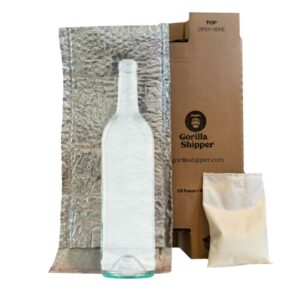
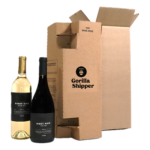
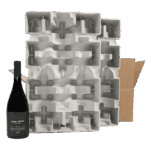
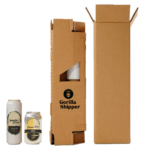
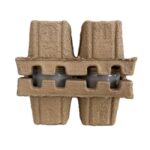
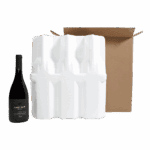
Most businesses audit carrier rates and negotiate contracts but never check whether their box dimensions are quietly inflating every invoice underneath those rates. Gorilla Shipper’s boxes for bottles, jars, and cans are sized to the product itself, not padded to fit a generic corrugated size, which eliminates excess dim weight by design.
How to Reduce Dimensional Weight Charges Without Switching Carriers
Right-size the box. That’s the highest impact change available and it doesn’t require a new carrier contract. For fragile goods, product-specific packaging beats standard corrugated with filler on both fronts, smaller box means lower dim weight and better protection in the same decision.
Pull recent carrier invoices and check billed weight against actual weight on a sample of shipments. A consistent gap means dim weight, and it’s telling you something about your box sizing worth acting on. Recalculate whenever products, packaging, or carrier contracts change. Gorilla Shipper’s purpose-built boxes are sized to the product with ISTA-certified transit protection on top.
The 2026 USPS Dimensional Weight Change: What It Means for Your Business
USPS is dropping its dim divisor from 166 to 139 and adding ceiling rounding, effective July 12, 2026. For businesses using USPS because it’s cheapest for bulky lightweight products, this closes that gap. Dim weight charges on those shipments are set to increase 15 to 20 percent.
Audit your USPS shipments by dim weight now, not after the first inflated invoice. Identify the products and box sizes with the biggest gap between actual and dim weight. Model out what a 15 to 20 percent increase looks like at your order volume. Then either right-size the packaging or model whether a different carrier becomes more competitive once USPS’s advantage narrows.