










How to Choose the Right Box Size for Shipping Fragile Products
Box size feels like a minor detail. It is not. It is one of the most expensive mistakes a small business can make in their shipping operation, and most of them are making it without knowing.
Too big and your fragile product moves around inside the box during transit. Movement causes breakage. Too small and the box walls press against the product and crush it under stacking weight. Both outcomes cost you more than the box itself. The refund, the replacement, the re-shipping, and the customer you just lost.
Getting box size right is a business decision. This guide walks you through everything. How to measure a box for shipping, standard shipping box sizes, dimensional weight, the two-inch rule, wall construction, and when standard sizes stop working altogether for fragile products.
Why Box Size Is a Bigger Problem Than Most Businesses Realize
Most businesses that ship fragile products focus on what is inside the box. The product quality, the presentation, the insert. The box itself is an afterthought. Grab something that fits, tape it up, done.
That approach works until it doesn’t. And when it stops working, it gets expensive fast.
Oversized boxes let fragile products shift
An oversized box has empty space. Empty space means the product moves during transit. Every bump, every toss, every conveyor drop, the product shifts inside the box and hits the walls. For glass bottles, jars, and candles, that contact causes chips, cracks, and full breakage. Padding helps but it does not eliminate movement the way a properly fitted system does.
Undersized boxes crush the product
A box that is too small for the product creates pressure on the contents. Under stacking weight in a delivery vehicle or warehouse, that pressure increases. For glass or ceramic items, it does not take much. And for boxes with too little clearance, the walls bow outward and the structural integrity of the carton drops.
Oversized boxes inflate your shipping cost
This is the one that surprises people the most. Carriers charge based on the higher of actual weight or dimensional weight. Dimensional weight is calculated from the size of the box. An oversized box increases your dimensional weight and adds cost to every single shipment. Not just occasionally. Every shipment, every time, for as long as you keep using the wrong size box.
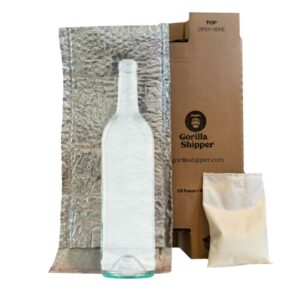
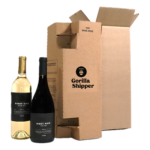
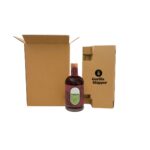
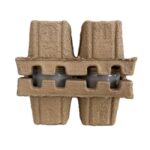
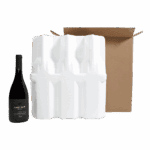
The fix is a box sized correctly for the product inside it. That is what Gorilla Shipper’s engineered insert-and-carton approach is built around. The outer carton is sized to the product. The molded or corrugated insert eliminates movement entirely. No oversizing for void fill. No under-sizing that creates pressure. Just the right fit, engineered for fragile containers specifically.
How to Measure a Box for Shipping (Length, Width & Height)
Knowing how to measure a box for shipping correctly is more important than most people realize. Carrier calculators use specific measurement rules, and getting it wrong means your rate estimate is off before you even print the label.
The basic format
Shipping boxes are measured as Length x Width x Height. Length is the longest side. Width is the next longest side. Height is how tall the box stands when sealed and ready to ship.
Always measure the exterior of the assembled, packed, sealed box. Not the interior. Not the flat blank before assembly. The exterior of the box once it is closed and ready to go. That is the number that goes into carrier rate calculators.
Rounding rules
UPS and FedEx both round up to the nearest whole inch on each dimension. So a box measuring 11.4 inches on the longest side gets entered as 12 inches. USPS accepts decimals, so you can enter 11.4 as-is. This matters because rounding up on all three dimensions can bump you into a higher dimensional weight calculation than your actual box size would suggest.
How to calculate girth
Girth is used for oversize checks. The formula is 2 x Width + 2 x Height. Combined length plus girth is the number carriers use to determine whether a package triggers oversize surcharges. USPS Ground Advantage allows up to 130 inches combined length plus girth. UPS allows up to 165 inches before Large Package Surcharges kick in.
How to measure a box for USPS specifically
USPS measures length as the longest dimension of the package. Girth is measured at the widest point of the package’s cross-section. For USPS Ground Advantage, the combined length plus girth limit is 130 inches. Priority Mail and Priority Mail Express have a 108-inch combined limit. USPS also accepts decimal measurements, so you do not need to round up the way you do with UPS and FedEx.
How to measure a box for UPS specifically
UPS uses the same L x W x H exterior measurement format. Round each dimension up to the nearest whole inch. UPS uses 139 as the domestic DIM divisor for dimensional weight calculations. The Large Package Surcharge triggers when the longest side exceeds 96 inches or combined length plus girth exceeds 165 inches. Always use the packed, sealed exterior dimensions, not the box blank or the interior cavity.
Standard Shipping Box Sizes: A Quick Reference Chart
Understanding standard shipping box sizes helps you match your product to an available size before you order. Here are the most commonly stocked corrugated sizes and what they are typically used for. Use this as a quick shipping box size chart before placing your next order.
Common eCommerce box sizes
6x4x4 – Best for small accessories or single small jars, lightweight items. Good for samples and small retail orders.
8x6x4 – This one is great for small product boxes, single candles, small food jars. One of the most common sizes for light ecommerce orders.
10x8x6 – Best for mid-size ecommerce. You can ship out single bottles, small multi-item orders, and standard retail packaging.
12x9x6 – This configuration is mostly used in ecommerce. You can fit a range of single bottles and standard jar sizes. And it’s actually a good all-rounder for small business shipping.
14x10x8 – A great mid-size domestic box. Works really well for larger jars, two-bottle configurations, and medium product sets.
16x12x8 – You can ship out multi-bottle, multi-jar, or larger single products with this configuration. The box however is frequently used for wine and beverage shippers.
18x12x12 – Usually used for bulkier products and larger domestic orders.
24x18x18 – Best pick for large domestic shipments, multi-case orders, and industrial-size packaging.
USPS flat-rate box dimensions
USPS Priority Mail flat-rate boxes come in fixed sizes. Small flat-rate box: 8-5/8 x 5-3/8 x 1-5/8 inches. Medium flat-rate box: 11 x 8-1/2 x 5-1/2 inches or 13-5/8 x 11-7/8 x 3-3/8 inches depending on configuration. Large flat-rate box: 12 x 12 x 5-1/2 inches or 23-11/16 x 11-3/4 x 3 inches.
Internal vs. external dimensions
This is a distinction that catches a lot of businesses out. Internal dimensions are what your product and insert fit into. External dimensions are what the carrier measures and charges on. The difference between internal and external on a standard corrugated box is roughly the wall thickness, which can be anywhere from a quarter of an inch for single-wall to half an inch or more for double-wall. Always verify both when specifying a box for your product.
Gorilla Shipper’s product-specific sizes are built around the exact internal dimensions required for each container type. The external dimensions are kept as compact as possible to minimize dimensional weight. That is the purpose-built advantage over standard corrugated sizes.
What Is Dimensional Weight and How Does It Affect Your Shipping Cost?
Dimensional weight is the reason an oversized box costs you more on every shipment. And it is one of the most misunderstood cost drivers in ecommerce shipping.
How dimensional weight works
Carriers charge based on whichever is higher. It can be the actual weight of the package on a scale, or simply the dimensional weight calculated from the size of the box. If your box is large relative to how heavy the contents are, the dimensional weight will be higher than the actual weight. And you pay the higher number.
The formula for UPS and FedEx domestic shipments is Length x Width x Height divided by 139. The result is the dimensional weight in pounds. USPS uses 166 as the divisor.
A simple example:
A 12x12x12 inch box weighing 7 lbs actual weight. UPS and FedEx calculation: 12 x 12 x 12 = 1,728 divided by 139 = 12.4 lbs DIM weight. You pay for 13 lbs, not 7. That gap between actual weight and billed weight is money leaving your business on every single shipment.
Now apply that to a business shipping hundreds of orders a month. The overspend adds up fast.
The fix
Right-size the box. Try eliminating the void space. Use a box that fits the product closely so the dimensional weight calculation reflects the actual size of the product, not the size of the empty space around it.
Gorilla Shipper’s flat-pack boxes are sized to the product. They are not padded out with excessive void fill to make a standard size work for a product that does not fit it. That means lower dimensional weight, lower shipping cost per unit, and fewer damage claims from product movement in oversized boxes. Knowing how to measure a box for shipping and then actually using the right size is where the savings come from.
Choosing the Right Box Size for Fragile Products: The Two-Inch Rule
The two-inch rule is the standard sizing guideline for fragile goods. It says you need at least two inches of clearance between your product and the box wall on every side, filled with cushioning material. That clearance creates the buffer zone that absorbs impact before it reaches the product.
For glass bottles, jars, ceramics, and breakable items, this rule makes sense in principle. But it has a problem in practice.
Too much clearance is just as dangerous as too little
Two inches of cushioning absorbs impact. But if the cushioning shifts during transit, the product moves. And a moving glass bottle inside a box is the most common cause of breakage in shipping. It is not always the drop that breaks the bottle. It is the bottle sliding across the box floor and hitting the wall, or two bottles colliding because the padding between them compressed and they made contact.
The two-inch rule assumes the cushioning stays in place throughout the entire shipping journey. In reality, it often does not.
The better approach for fragile containers
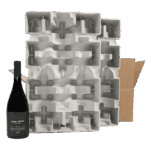
Gorilla Shipper’s molded insert approach removes the guesswork entirely. Instead of relying on cushioning to stay in place, the molded insert holds each container in a fixed position. There is no clearance to calculate. There is no movement to worry about. The product is physically secured in its own pocket and cannot move regardless of what the box experiences on the outside.
For businesses shipping bottles, jars, or cans, this is a more reliable solution than the two-inch rule. It is also simpler. You do not need to calculate clearance for each SKU. The insert is built to the product dimensions. The product goes in, stays in, and arrives intact.
Single-Wall vs. Double-Wall Corrugated: Which Box Strength Do You Need?
Choosing the right box size is only part of the equation. The next important aspect is the strength of the corrugation, especially when we are shipping fragile and heavy products.
Single-wall corrugated
One fluted layer between two liners. Three layers total. This is the standard construction for most general ecommerce boxes. It handles lightweight, non-fragile goods well and is the most cost-effective option for basic shipping. For glass bottles, filled jars, or anything fragile, single-wall starts to fall short under stacking pressure and impact.
Double-wall corrugated
Two fluted layers and three liners. Five layers total. Significantly stronger under stacking and compression. This is the right construction for glassware, ceramics, dense products, and anything that needs real structural protection in a parcel network. Most heavy duty shipping boxes are double-wall.
Triple-wall corrugated
Three fluted layers and four liners. Seven layers total. Industrial-grade construction for heavy freight, pallet shipments, and exports. Most ecommerce businesses will not need this unless they are regularly shipping above 70 lbs per package.
ECT and burst strength ratings
ECT, or Edge Crush Test, measures how much vertical stacking pressure the box walls can handle before collapsing. For parcel shipping, ECT is the most relevant rating. 32 ECT is standard ecommerce. 44 to 48 ECT is heavy duty, suitable for glass and fragile products.
Burst strength measures puncture resistance. It is an older standard, less relevant for modern parcel networks where stacking failure is more common than puncture.
Gorilla Shipper’s ISTA-6-FedEx-A certified construction goes beyond both. It covers drop, shock, vibration, and compression testing as a complete system. For businesses that cannot afford breakage in transit, that certification is the standard worth working to.
How to Measure a Box for USPS vs. UPS vs. FedEx – What’s Different
Each carrier has its own sizing rules and surcharge thresholds. Knowing how to measure a box for shipping across different carriers means you can choose the right service for each shipment and avoid triggering surcharges you did not plan for.
USPS sizing rules
USPS measures length as the longest dimension. Girth is 2 x Width + 2 x Height measured at the widest cross-section. Combined length plus girth limits: 130 inches for Ground Advantage, 108 inches for Priority Mail and Priority Mail Express. Weight limit is 70 lbs across most USPS services. USPS accepts decimal measurements so you do not need to round up the way other carriers require. When you need to know how to measure a box for USPS, start with the packed exterior and work from there.
UPS sizing rules
UPS measures the exterior length, width, and height of the packed box, then rounds each dimension up to the nearest whole inch. DIM divisor for domestic shipments is 139. Large Package Surcharge triggers when the longest side exceeds 96 inches or combined length plus girth exceeds 165 inches. UPS also charges additional handling fees. This is mainly for packages with a longest side over 48 inches or second longest side over 30 inches. It is best to know how to measure a box for UPS correctly upfront. This way you can yourself from all sorts of billing surprises after the shipment goes out.
FedEx sizing rules
FedEx uses the same exterior measurement format as UPS. They round up to the nearest whole inch. DIM divisor is also 139 for domestic. Large Package Surcharge and Additional Handling thresholds are similar to UPS. FedEx adds residential delivery surcharges for home deliveries, which is relevant for most ecommerce shipments.
The practical tip that matters most
Always measure the packed, sealed box. Not the empty box. Not the flat blank before assembly. The packed, sealed, ready-to-ship exterior. The product inside, the insert system, and the closed flaps all affect the final external dimensions. What you enter into the carrier calculator needs to reflect what the carrier is actually going to measure at the counter or on their belt scanner.
Using exterior dimensions from the assembled box is the only way to get an accurate rate estimate and avoid unexpected surcharges at billing.
When Standard Box Sizes Don’t Work: The Case for Product-Specific Packaging
Standard corrugated sizes work well for a lot of products. But there is a whole category of products for which they genuinely do not work. And businesses shipping those products spend a lot of time and money trying to make standard sizes fit before they find a better solution.
The products that do not fit neatly into standard corrugated sizes are almost always cylindrical, round-bottomed, or irregularly shaped. Wine bottles. Beer bottles. Glass candle jars. Mason jars. Sauce bottles. Olive oil bottles. These are round or tapered, and standard rectangular corrugated boxes have no way to hold them without excessive void fill around the sides.
The problem with excessive void fill
Void fill around a round container does two things that both cost you money. First, it increases the dimensional weight of the shipment. A box padded out with crinkle paper or air pillows around a round bottle is larger than it needs to be, and that size shows up in your carrier invoice on every shipment. Second, it does not reliably prevent movement. Void fill compresses and shifts during transit. A bottle surrounded by loose fill is not a secured bottle. It is a bottle waiting to slide.
Product-specific packaging eliminates both problems
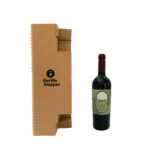
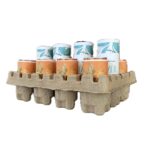
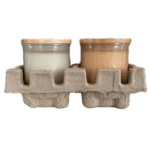
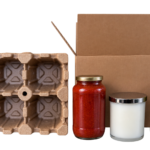
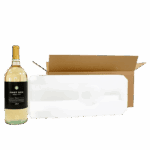
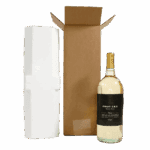
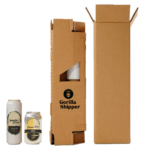
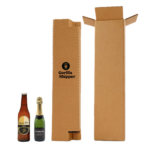
Gorilla Shipper’s packaging is engineered to the exact dimensions of the containers it is designed for. Wine bottles, beer cans, candle jars, mason jars, each product type has a box and insert system designed around its actual shape and weight. The insert holds the container in a fixed position. The outer carton is sized to the insert, not to a standard corrugated size chart.
That means no excessive void fill. No unnecessary dimensional weight. No product movement. And no need to calculate two-inch clearances for round containers that do not sit neatly in rectangular spaces.
The use cases are exactly the businesses that struggle most with standard sizing. Wineries doing direct-to-consumer shipping. Craft breweries running subscription clubs. Candle brands scaling their ecommerce. Hot sauce producers and olive oil sellers shipping glass bottles to retail customers. For all of these, product-specific packaging is not an upgrade. It is the right solution for the product type.