








Heavy Duty Shipping Boxes: How to Choose the Right Corrugated Strength for Your Product
Most people pick a shipping box based on size. Does the product fit? That works fine until it doesn’t and you you are dealing with crushed corners, blown-out bottoms, broken glass, and customers who are not coming back.
Box strength matters as much as size. For fragile, heavy, or high-value products, getting it wrong isn’t just a packaging problem – it’s a costly one. Refunds, replacements, re-shipping, damage claims: it all adds up. Most of it is avoidable with the right corrugated strength from the start.
This guide covers everything you need to know to choose the right sturdy shipping boxes for your product – wall types, ECT ratings, flute profiles, insert systems, all of it. Let’s get into it.
When Standard Cardboard Boxes Fail – and What to Use Instead
Standard single-wall cardboard boxes are fine for a narrow category of products. Lightweight, non-fragile items on short, straightforward delivery routes. Think books, clothing, small accessories. For that, a basic box does the job.
But the moment you move outside that category, things start to go wrong – and consistently so.
Heavy products crush the bottom of a single-wall box under their own weight during transit. Fragile items like glass bottles and jars need more than a thin corrugated wall between them and the sorting conveyor. Dense products create concentrated pressure points that single-wall board cannot absorb. And anything travelling through a multi-stage parcel network, which is most ecommerce shipments, goes through enough handling that a weak box will show it.
The failure modes are predictable.
Corners crushed by stacking pressure. Bottoms blown out from impact. Board weakened by moisture mid-transit. When these things happen, the business pays – not the carrier.
The solution is sturdy cardboard boxes built for what you’re actually shipping. Not a generic size in single-wall corrugated, but the right wall construction, the right ECT rating, and the right insert system for the product inside.
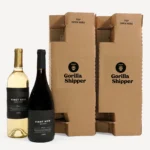
That is exactly what Gorilla Shipper’s ISTA-certified heavy-duty corrugated boxes are built for. The construction is engineered around fragile containers, not adapted from a general-purpose box.
The corrugated strength decision is a business decision. Frame it that way.
What Is a Double Wall Box? And When Do You Need One?
This is one of the most searched questions in corrugated packaging, and the answer is simpler than most people make it.
Corrugated cardboard is built in layers. Understanding the layers is what helps you pick the right box.
Single-wall corrugated has one fluted medium, the wavy layer, sandwiched between two flat liners. Three layers total. This is the most common corrugated construction and what most standard ecommerce boxes are made from. It handles lightweight, non-fragile products well. For anything heavier or more fragile, it starts to struggle.
Double-wall corrugated has two fluted layers and three liners. Five layers total. Significantly stronger under stacking pressure, more resistant to impact and puncture, and much better at protecting heavy or fragile contents. This is what most heavy-duty shipping boxes are made from. If you are asking what is a double wall box and whether you need one, the answer is yes, if you are shipping glass, dense products, or anything fragile.
Triple-wall corrugated has three fluted layers and four liners. Seven layers total. This is industrial-grade construction used for pallet freight, export shipments, and very heavy goods. Most ecommerce businesses will not need this unless they are shipping products above 70 lbs regularly.
When to use each:
Single-wall works for standard parcel shipping. If you are shipping something non-fragile, under 30 to 40 lbs, a single-wall is fine and it keeps costs down.
Double-wall is what you need for heavy, dense, or fragile goods. Glass bottles, filled jars, candles, anything that is either heavy or breakable.
Triple-wall sturdy shipping boxes is for industrial or pallet freight, exports, and products above 70 lbs. If you are shipping at that scale, you already know you need it.
ECT Rating vs. Mullen Burst Test: What the Numbers on Your Box Actually Mean
There are two main strength standards for sturdy shipping boxes. Most businesses have seen the numbers on the bottom of a box and had no idea what they meant. Here is what they actually tell you.
ECT – Edge Crush Test
ECT measures how much vertical stacking pressure the box can withstand before the walls collapse. The number tells you the pounds per linear inch of compression force the box can handle. A 32 ECT box handles less stacking pressure than a 48 ECT box. Simple.
For parcel shipping, ECT is the more relevant rating. When boxes are stacked in a delivery truck or warehouse, the walls are taking vertical compression force. A box that fails under that load means a crushed product. ECT tells you exactly how much that box can take.
The most common ECT grades you will encounter:
32 ECT is standard ecommerce. Fine for lightweight, non-fragile products in single-wall construction.
44 ECT is heavy-duty single-wall. Better stacking resistance, used for moderately heavy products.
48 ECT is double-wall. This is where you want to be for sturdy shipping boxes carrying fragile or heavy glass products. Heavy duty corrugated cardboard boxes at this rating handle the stacking forces of multi-stage parcel shipping without compressing.
Mullen Burst Test
The Mullen Burst Test measures puncture and impact resistance. It tells you how much outward pressure the wall can withstand before rupturing. Historically this was the standard test for corrugated, but for parcel shipping it is less relevant than ECT. Because in modern networks, for what we have seen, stacking failure is far more common than puncture failure.
If you see a box labeled with a Mullen number rather than an ECT rating, it is an older spec. For ecommerce shipping today, look for the ECT rating.
Beyond ECT: ISTA certification
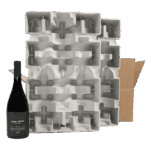
Gorilla Shipper’s Hexabox & Pulp packaging goes beyond ECT ratings. ISTA 6-FedEx-A certification covers drop testing, shock, vibration, and compression as a complete system. That means the box has been tested against real-world parcel shipping conditions, not just a single material strength number. ECT tells you about the board. ISTA certification tells you about the box as a complete protective system. For heavy duty corrugated boxes carrying fragile glass, that distinction matters a lot.
Flute Types Explained: B, C, E, and BC Double-Wall
The flute is the wavy layer inside the corrugated wall. Different flute profiles have different physical properties, and the right one depends on what you are shipping.
This is not a deep technical dive. It is a quick decision guide.
C-flute
The most common flute type. Good crush resistance, reasonable cushioning, works well for standard ecommerce and retail shipping. Most of the generic corrugated boxes you encounter are C-flute. It is the all-rounder and the baseline for most sturdy cardboard boxes for shipping.
B-flute
Thinner than C-flute with better puncture resistance. The thinner profile also makes it good for printing. B-flute is commonly used for canned goods and glass containers because of its puncture resistance. If you are shipping products in glass that are prone to chipping or surface damage, B-flute is worth knowing about.
E-flute
Very thin, very smooth surface. Primarily used for lightweight retail packaging and gift boxes where print quality matters more than structural strength. Not what you want for heavy duty shipping boxes in a parcel network.
BC double-wall
This is the combination of B-flute and C-flute in a double-wall construction. It is the most common heavy duty corrugated configuration and the one most relevant for businesses shipping glassware, dense products, or anything that needs serious structural protection. The B-flute provides puncture resistance. The C-flute provides crush resistance. Together they make a box that handles both.
Gorilla Shipper’s Hexabox & Pulp packaging uses engineered corrugated construction optimized specifically for bottle, jar, and can protection in parcel networks. It is not a standard off-the-shelf flute profile. It is built around the specific demands of fragile glass containers in transit.
Sturdy Shipping Boxes for Fragile Products: Why Wall Type Alone Is Not Enough
Here is something a lot of businesses figure out the hard way. A double-wall box is stronger than a single-wall box. But strength alone does not prevent breakage for glass, liquid, or fragile goods.
Wall construction protects against external forces – stacking pressure, impact, puncture. But what actually breaks most fragile products during shipping is internal movement. The product shifting inside the box, making contacting the walls, colliding with other containers, sliding through every bump and toss in the delivery chain.
A fragile item in a double-wall box with no insert system can still break. The box holds up fine. The product moves inside it and breaks anyway.
This is why sturdy shipping boxes for fragile products need two things working together: a strong outer carton and an inner insert that eliminates product movement entirely. The outer carton absorbs external force. The insert holds the product fixed regardless of what happens outside the box.
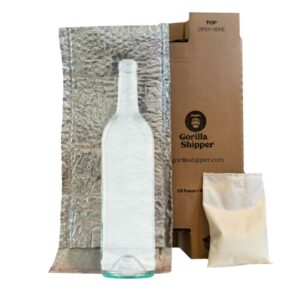
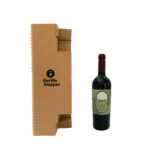
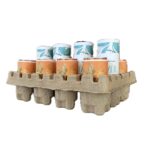
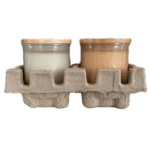
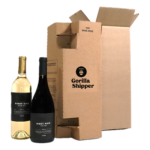
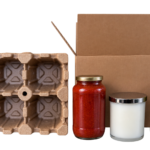
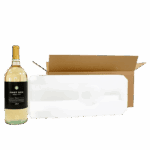
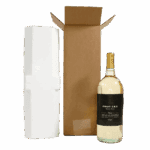
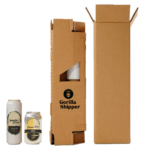
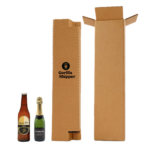
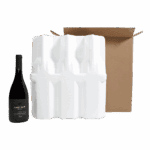
This is exactly what Gorilla Shipper’s system is built around. Our heavy duty corrugated cardboard boxes pair with pulp, corrugated & foam inserts designed specifically for bottles, jars, cans, and breakables. The insert holds each container individually in its own pocket – no sliding, no contact, no movement.
A business shipping wine bottles, glass candle jars, or mason jars needs both. The corrugated strength handles the external environment. The insert handles the internal one. Remove either and the system is incomplete.
How to Choose the Right Heavy Duty Corrugated Box for Your Product
A practical decision framework. Map your product to the right box specification before you order anything.
Lightweight fragile goods – glass under 5 lbs
32 ECT single-wall corrugated with a molded or corrugated insert. Single-wall handles the stacking load at this weight, but the insert is non-negotiable. Small glass jars, 4oz candles, and similar items fall into this category.
Moderately heavy fragile goods – glass 5 to 50 lbs
42 to 44 ECT single-wall with insert. This is where you need sturdier shipping boxes with real structural strength. A 750ml wine bottle, a pint mason jar, a standard glass candle jar, these all sit in this weight range. Single-wall is sufficient with the right ECT for shipping 1-4 containers.
Heavy dense goods – 20 to 100 lbs
44 to 48 ECT double-wall. Heavy duty shipping boxes at this weight range need to handle both the product weight and the stacking forces of being at the bottom of a loaded delivery vehicle. If the product is also fragile, the insert system becomes even more critical. Single-wall is not enough to ship 4-6 750 ml bottles. Double-wall with a fitted insert is the right specification.
Industrial or pallet freight – 70 lbs and above
Triple-wall or custom-engineered corrugated. At this weight, you are likely moving into freight rather than parcel shipping. Heavy duty corrugated boxes at this specification are built for industrial handling, not standard parcel networks.
Other factors to consider:
Humidity and moisture. If your product is shipping through regions with high humidity or in temperature-controlled environments, the board specification needs to account for moisture exposure. Wet corrugated loses a significant portion of its ECT rating.
Multi-carrier routing. Every carrier handoff means more sorting events, more handling, more drops, more compression. If your shipment changes hands, spec up.
Stacking height. Boxes stack in warehouses and delivery vehicles, and the bottom box takes all the weight. For products sitting in storage before delivery, staking resistance matters more than most shippers expect.
Heavy Duty Corrugated Boxes in Bulk: What to Look for When Ordering at Volume
Growing ecommerce businesses reach a point where packaging isn’t a one-off purchase – it’s a supply line. When you’re ordering heavy duty corrugated boxes at volume, there are things worth verifying before you commit that most businesses do not think to check until something goes wrong.
Consistent ECT spec across batches
This is the hidden cost of buying cheap corrugated in bulk. The first order comes in at 48 ECT. The next order, from the same supplier, comes in lighter because they switched board sources. Your damage rate climbs. You do not immediately know why. By the time you figure it out, you have already absorbed a wave of broken shipments. With Gorilla Shipper, the spec is consistent. Every batch of heavy-duty shipping boxes ships with the same corrugated specification. What you order the first time is what you get on every reorder.
Flat-pack storage efficiency
Bulk orders mean storing lots of boxes. Pre-assembled boxes eats warehouse space fast. Flat-pack corrugated stacks efficiently and takes up a fraction of the footprint. For any business ordering heavy duty shipping boxes at volume, flat-pack is not just a convenience, it is a practical necessity.
Container dimensions and shape
Each Gorilla Shipper insert is designed to fit a wide variety of container shapes and sizes. Check the listing specifications to validate compatibility with your container shape, diameter range, and height range.
Reorder lead time
Running out of packaging in the middle of a busy shipping period is a real operational problem. Know your supplier’s lead time before you commit. Gorilla Shipper ships from warehouses in Nevada, Indiana, and California, which means faster reorder turnaround regardless of where your business is based.
Gorilla Shipper’s bulk model
Tiered pricing across three levels – Bronze at $1,000, Silver at $2,000, Gold at $3,000 and above – with up to 15% off on qualifying orders. Consistent spec, flat-pack delivery, and fast reorder from three U.S. warehouse locations. For businesses placing regular bulk orders of sturdy cardboard boxes for shipping, that combination removes the most common pain points of buying corrugated at volume.